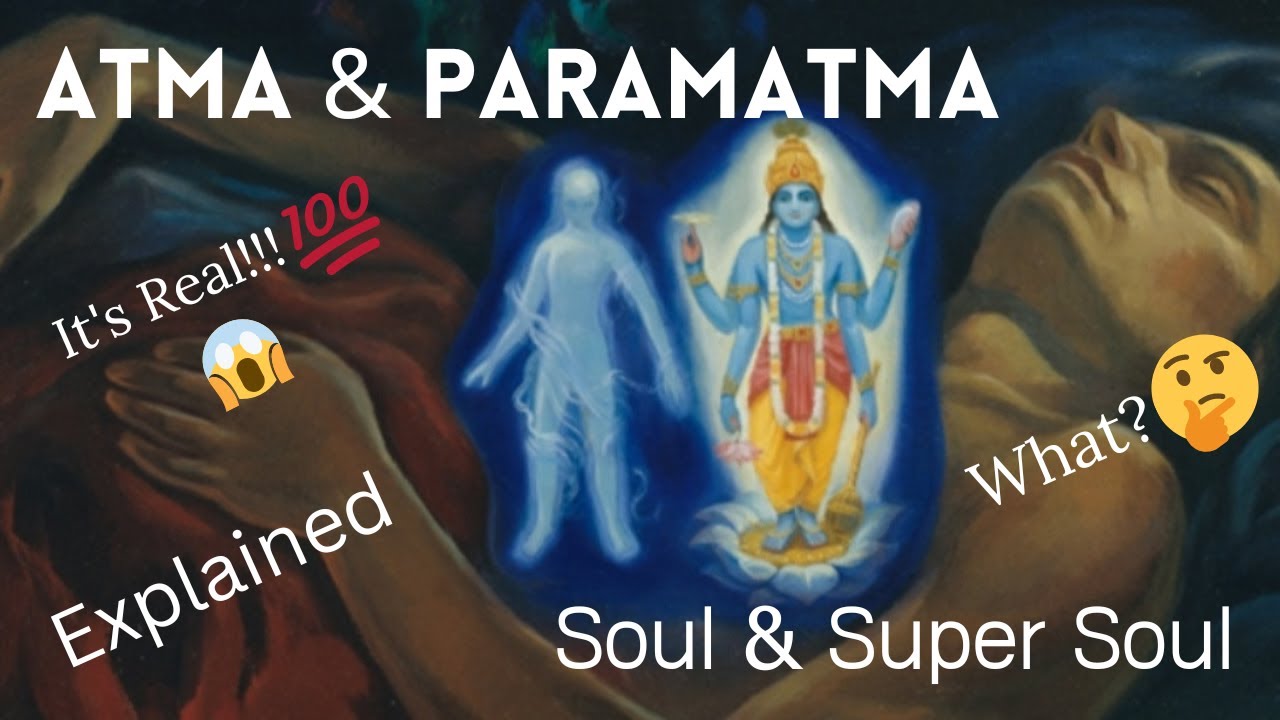
Definition: Atma refers to the immortal, individual soul or self within every living being.
Nature: It is the true essence of life, distinct from the body and mind. It is unchanging, eternal, and divine in nature.
Jivatma: When the Atma is identified with the body and mind, it is called Jivatma (the embodied soul), which experiences the cycle of birth and death.
Goal: To realize that one is the pure Self (Atma) rather than the mortal body.
2. Anatma (अनात्मा) - The Non-Self
Definition: Anatma refers to everything that is not the Self (Atma). It is the "non-soul" or material reality.
Components: This includes the body, mind, intellect, ego, senses, and the material world.
Characteristics: Anatma is transitory, changing, perishable, and ultimately illusory (Maya) compared to the eternal nature of the Atma.
Distinction: Spiritual ignorance (Avidya) causes the Atma to identify with Anatma (e.g., "I am this body"), leading to suffering and bondage.
3. Paramatma (परमात्मा) - The Supreme Soul
Definition: Paramatma is the Supreme Soul, Divine Self, or God (Brahman).
Nature: It is the limitless, formless, omniscient, and omnipresent ultimate reality.
Relation to Atma: While Atma is the individual soul, Paramatma is the universal soul, sometimes described as the "Atma of all atmans".
Analogy: Atma is often compared to a spark (chingiari) and Paramatma to the fire (agni); or Atma as a drop of water and Paramatma as the ocean.
Summary of Relationships
Atma and Paramatma: They are fundamentally identical in nature. The separation exists only at the level of the body-mind complex.
Goal of Life: To remove the false identification with Anatma (non-self) and achieve the union (Yoga) or recognition of the Atma as one with Paramatma.
Process: Through self-realization, the individual soul (Atma) realizes its identity with the Supreme Soul (Paramatma), thus breaking the cycle of birth and death.
once krishna took me - how he felt during rasa lila - nothing great about it - siva had done the same with composer of vaisnav jan to - yesterday i was teaching apprentice how to compose poem
Kuzhambu (often spelled Kulambu) is a thick, sour, and spicy South Indian gravy. It typically features a base of tamarind, fresh ground spices, and can include vegetables, lentils, or lentil dumplings.
Texture: Thick and stew-like.
Popular Varieties:
Kara Kuzhambu: A fiery, tangy gravy often made with small onions (shallots), garlic, and vegetables like drumstick or ladies' finger.
Puli Kuzhambu: Similar to Kara Kuzhambu but with a rich tamarind base and roasted spice blends.
Mor Kuzhambu: A milder, comforting yogurt (buttermilk) and coconut-based curry, typically made with ash gourd or okra.
Vatha Kuzhambu: A tangy, spiced gravy flavored with sun-dried berries or vegetables (like manathakkali or sundaikkai).
Rasam (ரசம்)
Rasam is a light, watery broth or soup packed with tanginess and sharp pepper-cumin heat. It is a lighter dish meant to be mixed with rice or sipped as a palate cleanser or digestive aid after a heavy meal.
Texture: Thin and soupy.
Key Ingredients: Tamarind pulp, tomatoes, freshly ground black pepper, cumin, and garlic.
Popular Varieties:
Thakkali Rasam: The everyday tomato rasam.
Poondu Rasam: A highly aromatic garlic rasam.
Jeeraga Rasam: A soothing, cumin-dominant rasam.
Paruppu Rasam: Made using the water from cooked toor dal (lentils), giving it a slightly richer body.
The Main Differences
Consistency: Kuzhambu is thick, acting as the main flavorful curry for a meal, while Rasam is thin and acts as a digestive soup.
Flavor Profile: Kuzhambu highlights robust spice blends and sour-salty combinations, whereas Rasam sharply balances sweet, sour, and heavily peppery/spicy notes.
Role in a Meal: In a traditional meal, Kuzhambu is usually served for the first few courses with rice, while Rasam is always poured over rice for the final course or drunk from a glass.